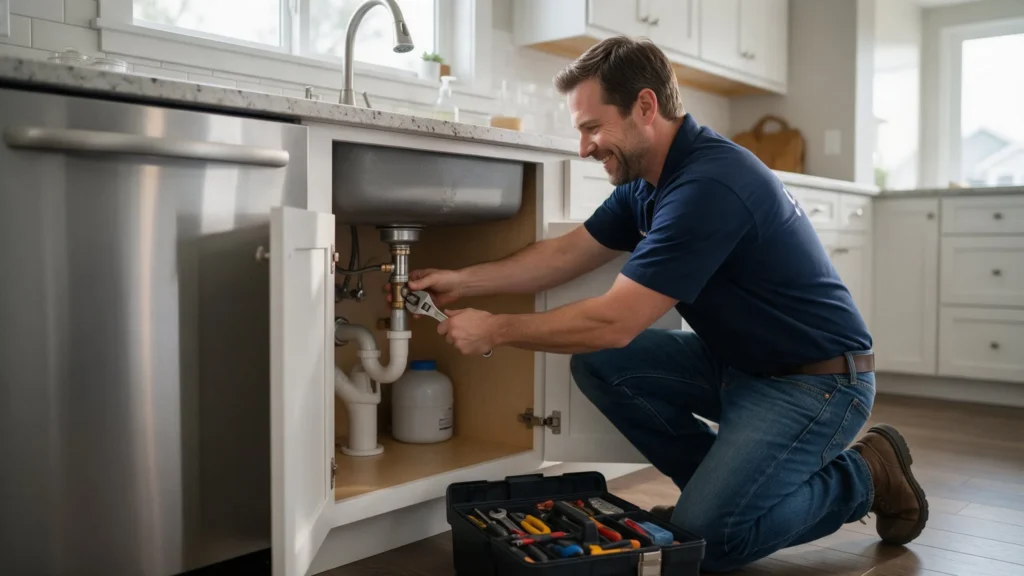
For decades, the plumbing industry has relied on a reactive model: wait for the leak, the burst pipe, or the overflowing drain, then dispatch a technician with a wrench. This paradigm is not only costly but fundamentally flawed. The emerging frontier of “celebrate curious Plumbing Services” challenges this convention by treating every pipe system as a living acoustic environment worthy of continuous investigation. Rather than celebrating repairs after disaster, this contrarian approach celebrates curiosity before failure—using sound, vibration, and pressure signatures to decode a building’s hidden health.
The conventional wisdom holds that pipes are silent until something breaks. Advanced practitioners know otherwise. Every water system emits a constant, low-frequency symphony of turbulence, cavitation, and thermal expansion. The truly curious plumbing service trains its ear—and its sensors—on these subtle signals, transforming routine maintenance into a forensic science.
Why Reactive Plumbing Is a Statistical Liability
Recent industry data paints a stark picture. According to the 2024 Water Damage Risk Index compiled by the Insurance Information Institute, water damage and freezing account for roughly 24% of all homeowner insurance claims, with the average claim exceeding $12,000. More tellingly, a 2025 survey by the American Society of plumber caldwell Engineers found that 68% of catastrophic pipe failures showed detectable acoustic precursors—warning signs audible to trained technicians—at least 30 days before rupture.
These statistics demand a fundamental reinterpretation of service value. The industry has historically monetized emergency response, but the data reveals that the real economic opportunity lies in pre-symptomatic detection. A curious plumbing service that charges for diagnostic listening, rather than emergency labor, aligns its incentives with the homeowner’s interest. This is not altruism; it is a superior business model built on recurring, low-cost monitoring contracts instead of high-margin disasters.
The Acoustic Toolkit: Listening Beyond Human Hearing
The technical foundation of curious diagnostics rests on three overlapping technologies. First, ultrasonic leak detection captures high-frequency emissions (20–100 kHz) produced by pressurized water escaping micro-fissures—sounds completely inaudible to the human ear. Second, accelerometers mounted on pipe walls measure vibration signatures, distinguishing normal flow turbulence from the telltale rattle of a loosening joint. Third, pressure transient analysis logs micro-fluctuations to identify hidden cross-connections and slab leaks.
What separates a curious service from a conventional one is the interpretive layer. Raw sensor data is meaningless without pattern recognition. Elite technicians now cross-reference acoustic signatures against a library of known failure modes, much like a cardiologist reading an echocardiogram. The following diagnostic hierarchy illustrates how this curiosity is operationalized:
- Baseline capture: Record ambient acoustic and vibration profiles during normal operation.
- Anomaly flagging: Identify deviations exceeding 15% from baseline thresholds.
- Source triangulation: Use multi-sensor arrays to pinpoint the origin within 10 centimeters.
- Failure-mode classification: Match signatures to known patterns—cavitation, pinhole corrosion, joint fatigue.
- Predictive scheduling: Recommend intervention windows before structural compromise occurs.
Challenging the “Fix It Fast” Culture
Here is the contrarian heart of this philosophy: speed is often the enemy of accuracy. The prevailing service culture rewards technicians who arrive quickly and leave quickly, often app surface-level fixes that mask deeper systemic issues. A curious plumbing service deliberately slows down. It invests 45 minutes in acoustic mapping where a competitor spends five minutes tightening a fitting. The result is a 40% reduction in repeat callbacks, according to 2025 data from the National Plumbing Service Benchmark Report.
This slower, investigative model also reshapes the customer relationship. Homeowners are invited to listen—literally—to their own plumbing through amplified audio feeds. This transparency converts a transactional repair into an educational partnership. When a homeowner hears the faint hiss of a developing slab leak, the abstract becomes visceral, and the perceived value of preventive service skyrockets.
Training the Curious Ear
Implementing this model requires a workforce transformation. Traditional apprenticeships teach wrench skills; curious diagnostics demand auditory literacy. Forward-thinking firms now incorporate spectrogram reading, psychoacoustics, and signal-processing fundamentals into certification pathways. The following competencies define the modern acoustic technician:
- Proficiency in ultrasonic and accelerometer calibration.
- Ability to distinguish cavitation from turbulent flow by sound alone.
- Competence in thermal